“Good times teach only bad lessons: that investing is easy, that you know its secrets, and that you needn’t worry about risk.”
- Howard Marks (2011)
Stocks are on track for a fourth good year in a row, and the cumulative total return of the S&P 500 Index over the past five years has been 96%.1 After a stretch like this, it's natural to feel good about portfolios. It’s also the right time to examine risk.
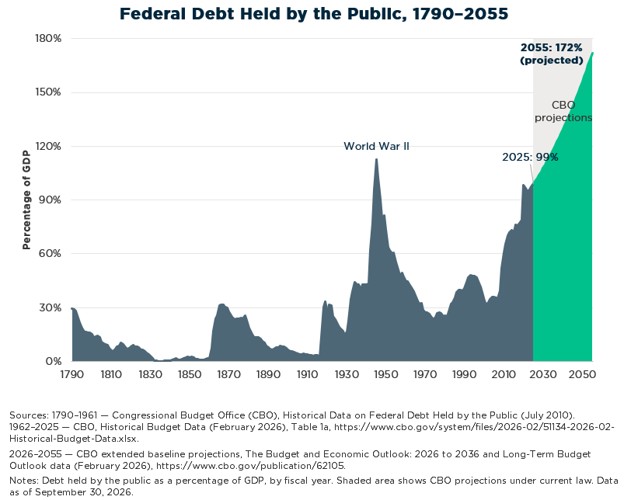
The federal debt now exceeds $40 trillion. Interest on that debt is over $1.2 trillion per year. The Federal Reserve just raised short-term interest rates, and 10- and 30-year Treasury rates recently matched their highest since 2002 (as European rates are also hitting multi-decade highs). How did we get here?
For decades, policymakers ramped spending with each crisis to smooth the business cycle: the Great Financial Crisis of 2008 (GFC), the Eurozone Sovereign Debt Crisis of 2010-12, the U.S. Debt Ceiling Crisis of 2011, persistently weak employment growth between the GFC and COVID, the short COVID recession in 2020, and the mini-U.S. Banking Crisis of 2023. Well-intentioned policymakers threw borrowed money at each sign of stress. Consequently, government debt grew much faster than Gross Domestic Product (GDP), and some of the normal risks of the private sector increasingly shifted to the public sector. The response to COVID was such that it required more than just borrowed money, so the Fed printed new money as well, swelling the money supply and ultimately bringing increases in inflation and interest rates after the usual lags. All the while, the population skewed older and Social Security and Medicare costs climbed, leaving Federal deficits even more intractable.
Persistent inflation above the Fed’s targets plus heavy demand for credit from the Treasury, from “hyper-scalers” building AI, and from the “reshoring” of U.S. manufacturing combine to push interest rates higher. Higher rates raise Federal interest costs and deficits which can push rates higher in a negative feedback loop. Moreover, AI's appetite for electricity strains the power grid and may add to energy costs.
The federal deficit has become too big to shrink under normal economic conditions. Social Security, Medicare, interest on the debt, and rising defense spending are growing deficits even during economic expansions. Slower economic growth would make the math worse. The only palatable solution to the conundrum is significantly faster economic growth.
If the economy could grow faster than the debt burden, deficits and interest costs would become easier to manage over time. But with the deficit now at 6% of GDP, that requires a lot of growth. AI is the only development on the horizon with the potential to boost GDP that much.
This is certainly the AI Moment, and it dominates most news feeds. Debate is polarized between “AI Boom” or “AI Doom,” with little room in the middle. Some are convinced AI will usher in a golden age of growth, while curing diseases and allowing more leisure; others that it will destroy jobs, enable widespread cyber disruption, or, in the extreme, pose existential risks. You’ve recently seen some artificial intelligence builders warn they may be creating something they might not be able to control.
As with nearly everything else, AI is now politicized, making it tricky to even mention. So, beyond AI growth and risk, we will just offer two observations: most recent AI debate is about whether we should regulate and put the brakes on AI development. Whatever one's view on regulation, AI has become central to national defense (modern warfare increasingly relies on AI-guided missiles and drones), and the U.S. and China are competing hard for the lead. In that context, any real slowing of AI development seems unlikely, no matter what alarms sound.
Debt, deficits, interest rates, and AI are each powerful crosscurrents! Where does this leave investors? These influences make the investment outlook unusually uncertain, and potentially more hazardous than recent experience may suggest. AI might save us. Otherwise, a financial reckoning likely looms eventually (and potentially sooner than later). On the other hand, if AI manages to super-charge growth and that obviates or defers a fiscal reckoning, there are still AI existential risks to dodge. How can investors plan for that? Simply, the most extreme AI scenarios are much like global thermonuclear war with respect to investing: from a portfolio construction perspective, such extreme scenarios are essentially “non-hedge-able” as investors can do little to protect against risks of that magnitude.
Back to more present concerns, the economy remains quite strong (though that strength is uneven). No Fed member saw downside risks to the current economic environment at the recent meeting of the Federal Reserve. The number of new business formations in the first half of this year hit a 20-year high (likely in part because AI tools make it easier). Additionally, while stock prices are higher this year, earnings growth has been stronger yet, so the P/E measure of stock valuations, while still above average, has moderated from year-end.
If inflation follows a “higher for longer” path, that is not a great environment for bonds, but it is not terrible for stocks in the long run. Moreover, persistently higher inflation could pressure the dollar, favoring international investments. If federal deficits continue to climb or capital needs for both AI buildout and manufacturing “reshoring” continue, that implies additional upward pressure on “real” interest rates (not just rates’ inflation component), which would not be positive for either bonds or stocks.
This is not to say portfolios should tactically lean against any of these risks, partly because no single portfolio tilt addresses all. However, more exposure to international stocks seems warranted. Also, when risk is highest, diversification, especially into market risk hedges, inflation hedges, and real assets, is the most likely to benefit portfolios. We will be thrilled if GDP growth accelerates (whether AI-driven or not) enough that deficits as a percent of GDP moderate. In that event, the stocks we hold may outperform our expectations. On the other hand, if AI doesn’t deliver a growth renaissance yet still consumes lots of capital, there may be some lean years ahead in which lower-risk portfolios and shorter-duration bond holdings may provide some cushion even if stocks give back some recent gains.
Let’s drill down a bit in one area: if bonds face headwinds from multiple fronts, why isn’t that also bad for stocks? Warren Buffett said, "interest rates are to stocks what gravity is to matter." Higher interest rates can indeed weigh on stocks, particularly in the short run, and most stock dips in the past have in fact been set off by higher interest rates. But most rate-induced market pullbacks in recent decades have started from higher interest rate levels than today’s. Moreover, the old Wall Street saw is “Three steps and a stumble,” meaning the first in a series of interest rate hikes (“steps”) by the Fed is usually followed by a higher stock market a year or so later, while after a few rate hikes (three in the adage, but the number holds no magic), markets often take a breather. However, over longer periods, stock earnings and dividends can grow to more than offset inflation while bonds’ fixed payments lose purchasing power steadily. Shorter-term bonds add stability and income to portfolios, but longer-term bonds may face headwinds.
Back to the longer-term (and the much more important and predictable) outlook, if today’s environment feels different, that’s because it is: never outside of WWII has the federal government been saddled with this much debt as a percent of GDP, and that changes most things investment-related. It means that investment risk is greater than investors have had reason to expect for decades. The next time there is economic distress (likely from some unanticipated corner), and if it occurs amid persistent inflation and bloated deficits, the Fed will likely have less freedom to respond with the usual rate cuts and quantitative easing, and Congress will have less room to bail out or backstop the crisis with stimulus spending that has become customary since 2008. Markets have certainly priced in good outcomes, but that says little about the likelihood of such outcomes being achieved.
In sum, investment risks appear to be much larger now than most recognize. On the other hand, we are in a massive innovation boom. More precisely, investment in the AI boom is unprecedented. In terms of that investment as a percent of GDP, this economic boom surpasses all others in the last 200 years! Consider: it is projected to be about 1.6 times larger than the 19th-century railroad build-out as a percent of GDP (1870-1890), about 3 times that of either interstate highways (1956-73) or Telecom & Fiber Optic (1993-2003), over 5 times the size of the Canals boom (1836-1841), and about 7 times the Electrification investment (1905-1925).2 Stated differently, from an investment perspective, it is projected to be larger than Highways, Fiber Optic, Canals, and Electrification combined! Those investments were each accompanied by massive gains in productivity. In this case, productivity enhancement remains to be seen. That implies both lots of potential upside and lots of risk.
Warren Buffett also often advised investors not to “bet against America.” History gives reason for optimism: time and again, new American-led technologies have propelled prosperity in ways few could have previously imagined. We hope AI is the next transformative advancement in a long, storied string. But tempering that are higher interest rates and a greater concentration of systemic risk than most recognize, this from decades of deferred risk now concentrated in the federal balance sheet. The cost of capital has risen, public borrowing needs are large, and stock valuations assume lots of good news. In that environment, the right posture is neither retreat nor euphoria, but disciplined participation: stay invested, stay broadly diversified, and remember that good times are most dangerous when they lead us to believe risk has disappeared.
1 Advisor View by Envestnet | Tamarac S&P 500 total return, cumulative from 9/30/21 through 9/30/26 as of 10/1/2026
2 https://www.wsj.com/economy/the-ai-build-out-is-becoming-the-biggest-economic-bet-in-u-s-history-c60716dd
The above information was obtained from various sources and is believed to be reliable. Foster & Motley does not guarantee the accuracy or completeness of such information provided by third parties. The information is given as of the date indicated.
This market commentary is for informational and educational purposes only and is not intended as a substitute for personalized financial advice. Foster & Motley assumes no obligation to update this information or to advise on further developments relating to it.